Monday, February 19, 2018

Social Media How To: Removing The Deceaseds’ Accounts

Pew Research Center recently published a study  on the amount of Americans using social media. The study found a whopping sixty-nine percent of people in the U.S. have at least one type of social media account. Even older adults are in on the trend, but what happens to a person’s photos, pins, likes, and hashtags when they die? Can family members remove the deceased’s account? It turns out, family members can do that and more since keeping the accounts for memorial purposes is an option as well. In this post, we will discuss how to remove or memorialize the Facebook and Instagram accounts of a deceased loved one.

#1: Facebook
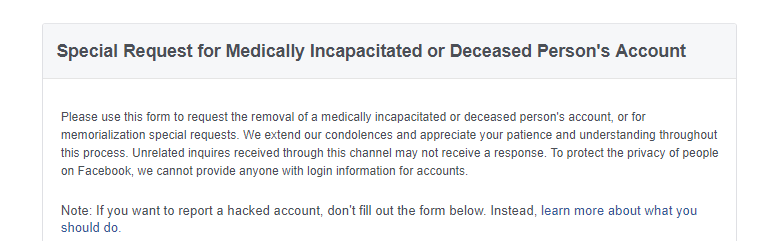
 

Facebook is the most widely used social media platform in the U.S., according to the Pew study. Luckily, the site’s removal process is fairly straightforward and easy to find on the web. Using this link, you can fill out a form to request the removal or memorialization of a medically incapacitated or deceased person’s account. Use the following steps to complete the form.

  1. First, enter your full name as well as the name of the person’s account you are trying to remove.
  2. Next, enter the URL of the person’s timeline as well as the email address tied to the account. You can copy and paste the URL when visiting their page.
  3. Finally, select whether you would like the account to be deactivated or memorialized. You can also make a special request or ask a question. Then, hit send.


There are a few important things to note about the removal process for a Facebook account. One, Facebook cannot provide anyone with another person’s login information. This could become a problem if you don’t know the deceased’s user email for the account. Two, Facebook has to verify that you are a family member of the deceased or the executor of their estate. This verification step helps to prevent people from deactivating a living person’s account.

#2: Instagram

Instagram has been steadily growing over the last few years. As of 2018, it’s the second most popular social media platform with a total of thirty-five percent of U.S. adults owning an account. The process of removing an Instagram account is very similar to the process of removing a Facebook account. Using this link, you can fill out a form to have a deceased family member’s account deactivated. Use the following steps to complete the form.

  1. Enter your full name and email address.
  2. Next, enter the name of the deceased. Copy and paste the URL of their account, and include a link to their account.
  3. Enter the date he or she died and provide proof that you’re a family member. A copy of the deceased’s death certificate, birth certificate, or proof that you are a representative of their estate is required.
  4. Finally, type in any comments or additional information. Hit send.


The Instagram removal process also has some additional information worth knowing. The process for memorializing an Instagram account is the same as removing it. However, the form is under a different link, which can be found here. Proof of death, such as a link to the deceased’s obituary, is still required for memorialization. Instagram’s website says the platform tries to prevent memorialized accounts from appearing in a way that would be upsetting to the deceased’s friends and family. Similar to Facebook, the deceased’s login information is protected and cannot be given out.

To contact Boyum Law Firm for help with creating estate planning documents, click here.

The post Social Media How To: Removing The Deceaseds’ Accounts appeared first on Boyum Law.


from WordPress http://ift.tt/2sM1qpJ
via IFTTT

Monday, February 12, 2018

Love, Marriage, and Estate Planning

Though it may not be obvious, love and estate planning go hand-in-hand. After all, protecting and providing for loved ones is what estate planning documents are for. Or, what they’re usually for. When it comes to married couples and estate planning, history has proven all bets are off. Some people choose to leave a sweet surprise for their surviving spouse. Others make bizarre requests, bequests, and demands. Read on to discover a round up of the sweet and sour couples that have used their estate plans to express their love – or lack thereof – to their spouses.

The Sweet: Flowers from beyond the grave

Radio and television comedian Jack Benny included a provision in his will to have flowers delivered daily to his widow, Mary Livingston. Livingston wrote about the sweet gesture in a biography about her husband of nearly 50 years. The title of the biography is ‘One Long-Stemmed Rose’ because according to Livingston’s obituary printed in the New York Times, “every day since Jack has gone the florist has delivered one long-stemmed red rose to my home.” The daily flower deliveries were said to contradict her husband’s TV persona as a penny pincher.

The Sour: Inheritance Restrictions

The will created by German poet Heinrich Heine falls on the opposite end of the love spectrum. After battling with spinal tuberculosis, Heine died and left his estate to his wife, Mathilde. However, his bequest came with one condition: she must remarry so that “at least one man would regret” his death. Mathilde fulfilled the condition and inherited the estate. No one knows if her second marriage proved to be as rocky as her first.

The Otherworldly: Yearly Seances

Escape artist Harry Houdini was a spiritualist, which is why he and his wife, Bess, promised each other that whoever died first would try to contact the other from beyond the grave, according to magictricks.com . The couple created a secret phrase in advance, which spelled out “believe” when the first letter of each word of the phrase was put together. After Houdini died on October 31, 1926, Bess began to conduct seances on the anniversary of his death. She gave up after receiving no contact for ten years.

The Snub: The Second Best Bed

William Shakespeare left his wife, Anne, his second best bed. The best bed was given to the couple’s daughter, Susanna, since she inherited the house. Though leaving your wife your second best bed instead of the best one would be considered a snub in modern society, experts say it wasn’t in 1616, according to this Telegraph article. They came to this conclusion after scientists at the National Archives and British Library used x-ray and infrared technology to study Shakespeare’s will. They discovered that the clause leaving his second best bed to his wife was added a month before his death. The scientists believe Shakespeare knew he was dying and since the best bed stayed with the house, giving his wife the second best bed ensured she was taken care of.

To contact Boyum Law Firm to create estate planning documents, click here.

The post Love, Marriage, and Estate Planning appeared first on Boyum Law.


from WordPress http://ift.tt/2F0xfgA
via IFTTT

Wednesday, February 7, 2018

Three Things to Consider When Leaving Inheritances

From family heirlooms to property to wealth, people often have a variety of items to pass on to heirs. However, knowing what you have to pass down is usually easier to figure out than deciding who gets what. Divvying up your estate doesn’t have to be difficult or lead to family warfare. With a well thought out plan in place, you can make sure all your heirs are happy. Read on to discover three things to consider when deciding how to split inheritances among heirs.

1. What does fair mean to you and your heirs?

Many people try to keep things fair and equal among their heirs. In order to do so, people often give each heir the same amount of assets. However, life isn’t fair or equal, so odds are the inheritances you gift shouldn’t be, either. As discussed in this Pittsburgh Post-Gazette article, parents often provide one child with more financial support than the others throughout their life. If you’ve paid for a child’s education or loaned them money, it’s fair to consider leaving them less than their siblings since you’ve given them more already. Additionally, if one of your heirs has a medical disability, it makes sense for you to leave them more. That way, they will have access to the financial resources they need even after you’re gone. However, caution and communication are important if you go this route. You should talk to your heirs about why you’ve made the decision to split things unequally in order to avoid hurt feelings and family warfare. Since splitting things unequally often does cause conflict, many people choose to split things equally. Ultimately, you know your heirs best and can make the decision that’s best for everyone.

2. What value does an item or asset have?

Some items or assets in your estate have obvious, concrete value, such as bank accounts. Other assets, like stocks or houses, have a value that fluctuates with time. Then you have a third category of items, which don’t have any monetary value but are sentimentally valuable. When it comes to the first and second categories, it’s easy to figure out how to divvy up who gets what based on how you decide to split inheritances. The third category is where it gets tricky. Items with sentimental value are tricky to divide because if more than one heir wants an item, there’s no way to split it equally. You can’t just give an heir another item worth the same amount of money because they don’t want a sentimental item for its monetary value.

To solve this problem, you can go about dividing sentimental items in a variety of ways:

      • Leave it to chance: Ask heirs if they’re interested in a sentimental item in order to see who wants it. Then, draw names out of a hat and let chance decide for you.
      • Split items equally: Divide up all the sentimental items in your estate and tell each heir they can only have one item.
      • Make the decision yourself: Give the item to a specific heir of your choice. It’s your estate, so you do have final say. However, if you choose this option, you should provide your heirs with an explanation as to why you’ve chosen a specific person to receive the item. This will help prevent hurt feelings and fights.

      The possibilities are endless when it comes to deciding how to divide sentimental items. Ultimately, you should choose the option that best fits your families needs.

      3. Do your heirs need a test run?

      Another important thing to consider when deciding how to leave inheritances is if your heirs need a test run with your assets. Suddenly receiving assets or being handed the family business could cause heirs to crash and burn, as explained in this Huff Post article. Assets could be wasted or the family business could struggle to stay afloat if your heirs aren’t prepared for the responsibility. One way to ensure your heirs are prepared is to give them a test run. With a test run, you can watch over your heirs and provide guidance. Your heirs will have a chance to ask questions and seek out advice on how to manage assets or run the business. If your heirs have experience with running the business or handling assets, they might not need a test run. Still, it doesn’t hurt to give them the chance to seek help while you’re still around.

      To contact Boyum Law Firm for help with estate planning, click here.

The post Three Things to Consider When Leaving Inheritances appeared first on Boyum Law.


from WordPress http://ift.tt/2BiHRYm
via IFTTT

Monday, January 29, 2018

Legacy Planning Is More Than Distributing Assets

Similar to estate planning, legacy planning involves preparing for the future. However, unlike estate planning, which involves creating documents for the distribution of wealth and protection against the unforeseen, legacy planning is often only used to distribute assets. While legacy planning is ultimately about passing assets down to family members, it can be used for much more. With a little extra work, you can use your legacy plan to share family history and morals. You can also make a lasting impact on your community by giving to charity.

Share family history

Your family is part of your legacy since those who survive you carry on the family name. You can help shape the legacy you pass down to your family through legacy planning. Sharing family history is one way to shape the legacy your family members carry on. Often times, family history is passed down orally. However, after a few generations, the stories of deceased family members are replaced, forgotten, or lost. One way to preserve your family’s history is by writing it down and including it in your legacy plan. Many people choose to include a letter to their family members in their estate planning documents. By including your family history in a letter, your family members will have a physical copy of their history to hold on to. The letter can be passed down from generation to generation, ensuring your legacy is well-protected.

Stick to your morals

Another way to pass your legacy down to family members is by creating a legacy plan that highlights your morals. Maybe you’re a big believer in volunteer work or believe family time is important. No matter what is important to you, there’s a way to include them in your legacy plan. Your first option is to include your morals in a letter to family members, just like you would your family history. Secondly, you could write an ethical will. An ethical will is not a legal document. However, it can be used to provide insight on why you have made certain legal decisions or why you’ve chosen to distribute assets a certain way. It can be especially useful if you choose to pass down your morals to family members by placing restrictions on their inheritances.

The third option of placing restrictions on inheritances is risky. It could cause you to seem controlling. This option usually involves creating an incentive trust. An incentive trust is a type of trust where the beneficiary has to complete a task to receive their inheritance or is restricted from spending trust money on certain things. However, your restrictions can be challenged in court and cannot break the law. So, this probably isn’t the best option to pass down your morals because it makes you look controlling and can be challenged in court.

Donate to Charity

Besides using legacy planning to share your morals and family history, you can use it to make a good impression in the community. Legacy planning is ultimately about the distribution of assets. By leaving some of your assets to a charity you care about, you can ensure your legacy is felt in the community, even after you’re gone. A charitable donation doesn’t have to big. It can be small and still have an impact. The impact will then help you create a legacy by making it possible for others to remember you positively thanks to your donation.

Legacy planning encompasses more than passing assets down to family members. By adding legacy planning to your estate plan, you can ensure all the bases are covered. To contact Boyum Law Firm for help with estate planning, click here.

The post Legacy Planning Is More Than Distributing Assets appeared first on Boyum Law.


from WordPress http://ift.tt/2DNH0Sf
via IFTTT

Wednesday, January 24, 2018

Where to Leave Instructions for When You Kick the Bucket

Kick the bucket, bite the big one, push up daisies. People use many idioms to soften the finality of death. Though death is inevitable and scary, you can alleviate some of the stress by estate planning since estate planning enables you to create a plan for your family to follow when you die. By predetermining what you’d like to happen to your possessions, assets, and remains, you can rest assured your loved ones have less to worry about and can grieve in peace. Read on to discover where to leave estate planning instructions for when you kick the bucket.

Distribute possessions in your last will and testament

Creating a last will and testament is an important part of estate planning because this document enables you to leave instructions on how you’d like your assets and possessions distributed. Leaving instructions on how you’d like to have your assets and possessions distributed is the key to avoiding family warfare when you die. Taking the guess work out of who gets what will prevent loved ones from arguing over who you’d have liked to receive your belongings. With this estate planning document in place, you can rest assured that your family will stick together, even after you die.

Use advanced planning to make funeral arrangements

Predetermining funeral arrangements requires a more advanced form of estate planning. Not many people choose to include this information in their estate plan because there’s not really a specific “spot” or space in an estate planning document where this information should go. At Boyum Law, we provide our clients with estate planning binders so they can keep all of their documents together. One of our binder tabs includes a place to file memorial instructions, but clients should also place this information elsewhere, such as with a close friend of family member. Your estate plan usually isn’t examined right away when you die, which means your instructions are likely to go unnoticed. By providing a trusted friend or family member with burial instructions, you can rest assured that your final wishes are known. Additionally, your family will not have to stress about planning a funeral if you have pre planned your own.

Leave a letter of final wishes

A letter of final wishes is technically not an estate planning document. However, it is a great way to leave instructions behind because it can be used to express your final thoughts and wishes to loved ones. You can include whatever you like in a letter of final wishes. Many people choose to share their hopes for the future. Others choose to leave behind instructions on how they’d like to pass down their legacy. No matter what you choose to include, writing a letter of final wishes is a great way to show your loved ones how much you cared.

To contact Boyum Law Firm to create estate planning documents and leave instructions of your own, click here.

The post Where to Leave Instructions for When You Kick the Bucket appeared first on Boyum Law.


from WordPress http://ift.tt/2F90X24
via IFTTT

Monday, January 15, 2018

Estate Planning for Children with Special Needs

If you have a child with special needs that depends on you financially and physically for care, creating an estate plan is important. With an estate plan in place, you can ensure your child is always provided for financially and physically, even if you’re no longer around. Read on to discover the estate planning steps you should take if you have a child with special needs.

1. Name a guardian

Naming a guardian is an important estate planning step to take if you have a child with special needs because it ensures your child is left in the care of a trusted individual if something happens to you. There are many factors to consider when choosing a guardian, which you can read about here. A guardian is named in a last will and testament. However, since your last will and testament is not typically looked at right away, a guardian should be named in other documents as well. A power of attorney document is a great place to list your choice of guardian since it’s one of the first documents that will be examined in the event you become incapacitated or die. A trust, if you have one, is also a good place to list your choice of guardian.

2. Write a letter of intent

Though a letter of intent, otherwise known as a letter of instruction, is technically not an estate planning document, it is an important document to create if you have a child with special needs. Writing a letter of intent enables you to share information about your child with their chosen guardian in order to help the guardian get to know your child. A letter of intent should include information about your child’s like and dislikes, capabilities and in-capabilities, daily routine, and medical history. Contact information for doctors, schools, and family members should also be left. You can also include a section dedicated to your final thoughts and wishes.

3. Create a special needs trust

A special needs trust is a unique estate planning tool. Unlike other methods of inheritance, a special needs trust enables you to leave your child financial resources without interfering with his or her ability to receive government aide. A variety of factors should be considered when creating a special needs trust, including:

  • What kind of life would you like for your child?
  • Does your child need financial resources to access educational or vocational training opportunities?
  • What type of medical care will your child need?
  • Is there an individual you trust enough to name as the trustee responsible for handling the trust?
  • Would you prefer to have someone who is not a family member or friend named as the trustee?

By creating these estate planning documents, you can ensure your child is left in the care of a trusted guardian in the event something happens to you. You can also ensure your child has access to the financial resources he or she will need throughout his or her life. To contact Boyum Law Firm to create these documents, click here.

The post Estate Planning for Children with Special Needs appeared first on Boyum Law.


from WordPress http://ift.tt/2Dzq4v7
via IFTTT

Monday, January 8, 2018

Tying Up Loose Ends: An Overview of a Personal Representatives Responsibilities

Cars, bank accounts, and family heirlooms. Bills, mail, and debts. These are all things people leave behind when they die. So, who is responsible for handling the deceased’s loose ends? In Nebraska, it’s the deceased’s personal representative. Read on to discover what a personal representative is and what the responsibilities of being a personal representative are.

What is a personal representative?

A personal representative, otherwise known as an executor, is the person responsible for handling an estate when someone dies. Typically, an individual names their personal representative in their last will and testament. If someone dies without a will, however, the court will name a personal representative for them. No special skills or knowledge is required to be a personal representative. The person named just has to be able to complete the tasks required of them as the individual responsible for handling the estate.

What are the responsibilities of a personal representative?

Personal representatives are responsible for a variety of tasks. This includes:

    • Carrying out written burial instructions
    • Submitting the deceased’s will to probate
    • Taking possession of the deceased’s assets and preserving them
    • Distributing assets to beneficiaries and heirs as listed
    • Paying bills and debts owed by the deceased
    •  Taking an inventory of the estate’s fair market value within the first three months
    •  Defending the estate against legal action if necessary

Ultimately, a personal representative is responsible for acting in the estate’s best interest. The individual is filing in to wrap up the deceased’s loose ends and to make sure the estate is handled and distributed smoothly. A personal representative should consider contacting a lawyer to minimize potential errors in handling the estate since they would be liable for errors that occur. To contact Boyum Law, click,  here.

The post Tying Up Loose Ends: An Overview of a Personal Representatives Responsibilities appeared first on Boyum Law.


from WordPress http://ift.tt/2qF7vmF
via IFTTT